
 English
 Português
 Español
 Français
 Italiano
 Nederlands
 Svenska
 Sort and classify
Living and Nonliving Things
Living or Nonliving in the Garden?
Cut out and sort eight garden pictures into living and nonliving groups. Observe, talk, and classify together.
- Age 4
- 15 min
- Easy
- Small group
- Sort and classify
Learning areas
Skills practised
About this activity
Children look at pictures of plants, animals, and objects they might find in a garden. Then they sort and glue them into two groups: living and nonliving.
As they talk about their choices, children practice sorting and begin to recognize that plants and animals are living things.
Learning objectives
- Sort eight pictures into living and nonliving groups.
- Recognize plants and animals as living things.
- Explain at least one choice using words or gestures.
The printable
Print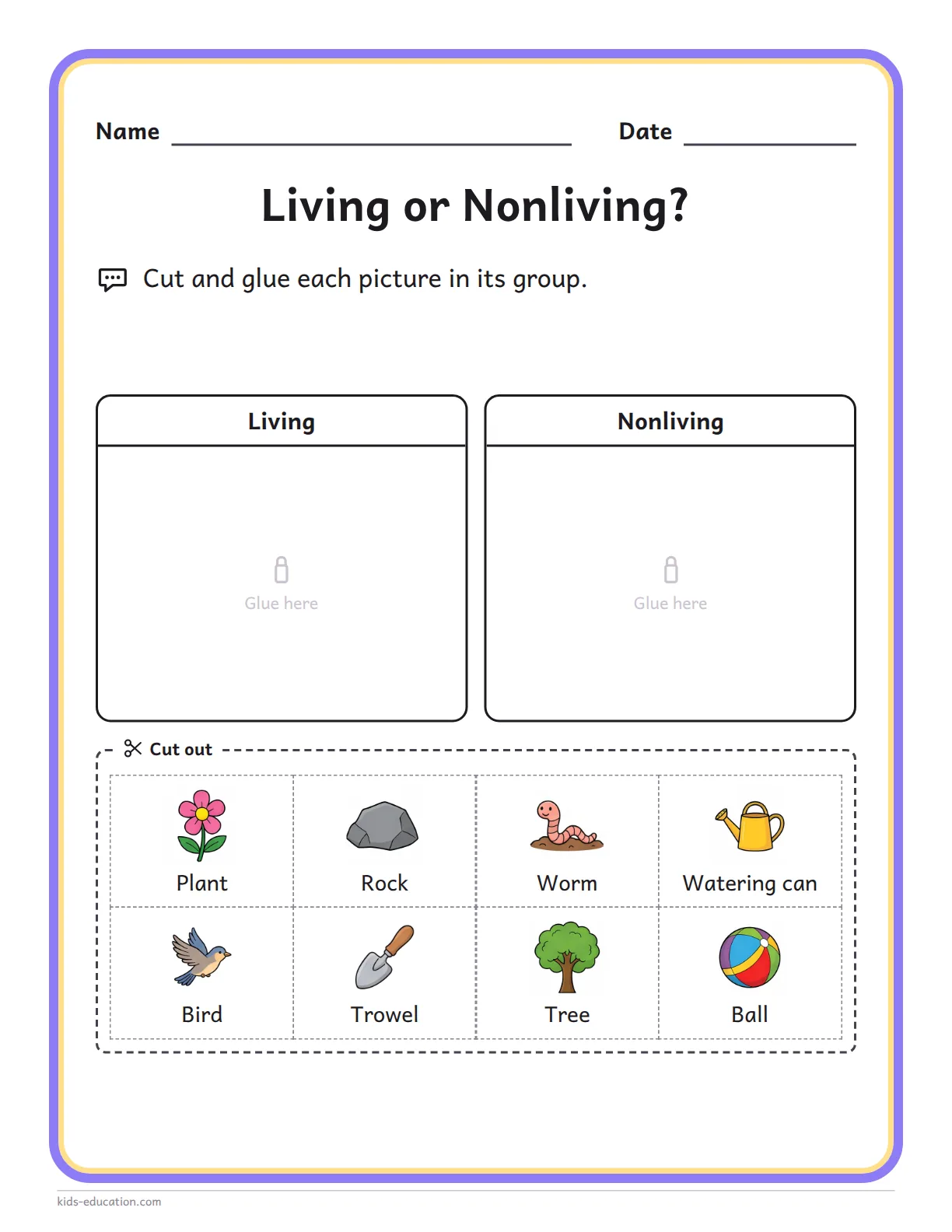
What you need
- Printed activity sheet
- Child-safe scissors
- Glue stick
Safety notes
Use child-safe scissors with close adult supervision. An adult can cut out the pictures if needed.
How to do it
- Print the sheet and gather the materials.
- Look at the pictures together and invite the child to name each one.
- Explain that plants and animals are living things, while objects such as the ball are nonliving.
- Point to the tree and show which group it belongs in.
- Help the child cut out the pictures.
- Invite the child to place each picture in a group, then glue it down.
- Look at the groups together and talk about the child's choices.
Teaching suggestions
- Read the picture and group labels aloud.
- If needed, offer two pictures at a time and help with cutting.
- Say, “The plant grows and needs water. It is a living thing.”
- In a group, invite children to take turns choosing pictures.
Variations
Make it easier
Cut out the pictures beforehand and offer them one at a time. The child can point to a group while you do the gluing.
Make it harder
Before gluing, invite the child to explain their choices by comparing one picture from each group.
Extend the activity
Look out a window or walk together in a garden. Find a living thing and something nonliving, and talk about them.
Talk about it
- What do you notice about the living things in the pictures?
- Why did you put the tree in that group?
- What do the worm and the bird have in common?
- What other living and nonliving things can you find in a garden?
What to look for
- Notice whether the child sorts the pictures into the two groups.
- Look for recognition that the plant and tree are living things, as well as the animals.
- Listen or watch as the child explains one choice.
 Odd one out
 Shapes
 Scavenger hunt